Thursday, September 9, 2010

Designing compelling characters

It's not easy to come up with classic characters. Think of basically any character that Tim Curry has played

He rocked in Congo. "Abso-lutely true"

Rocky Horror Picture Show: "Antici- - PAtion"
The Three Musketeers: "..." I can't quote him from this.

I don't know what movie this is even from.

It: "Down here we all float, Georgie"

? He kind of looked like this in Clue, he was the butler, but also Mr. Body, in one of the conclusions. Though I'm not sure he had a beard in Clue.

And he really challenged himself in this role. Great character actor.

After that brief example of how important memorable characters are to a great story - I come to these bits of advice courtesy of Suite101.com:

You need apparently only three things. 1) An interesting and plausible character back story:
The character backstory is necessary due to the effects it has on the character’s present self. Unless vital to the plot or story of a particular screenplay, no character is isolated from the rest of the world. He is affected by almost everything that surrounds him including his family background, education, friends, religion, birthplace and way of life.

Therefore, his actions, beliefs, thoughts and the way he reacts to events are somehow related to his past and the reasons why his present self is portrayed the way it is. Backstory should not be blatantly revealed but provide yet more subtle insight on the deeper workings of the character’s heart and mind.

Because of the fact that nuances in present characters can ultimately be explained by a rich background, in return a rich background can provide existing characters with a more dynamic personality.

2) the character goal;

All characters need to have a clear and measurable goal. This not only justifies their existence in the story but also allows the audience a chance to relate to the character as their goal or ‘reason for being’ is revealed throughout the story.

The Protagonist’s goal sets the story in motion and it is important to make sure this goal, though achievable is also something that is worth fighting or even dying for. After all, the stakes of the story are placed upon the importance of this goal. The protagonist will risk his entire being in order to achieve it so the gains he will receive should the goal be reached needs to be of equal or greater value. For example common goals in action films include saving innocent people or someone important to the protagonist. In romantic films the goal is often gaining the love of the protagonist object of affections.

The Antagonist’s goal which is in direct opposition to the protagonist’s bears the true task of creating conflict in the story which in turn allows the plot to develop further. Without conflict, the story will idle and will ultimately prove to be uninteresting and dull.
3) and the character motivation.
The character motivation also allows audiences an inside view of the character on a deeper level. Characters that are injected with plausible motivations are allowed to have an added dimension and the more personal the motivation the more likely it is for audiences to be able to understand and therefore relate to the character.

These motivations can be apparent to the character and audiences when played straight but can also be used to add twists and turns to the story should the writer hold back the reveal.

Similar to the character goal, the character motivation also has to have as much intensity as needed to support the genre base of the story. Because screenplays deal with events that are critical to the character’s existence, the character motivation needs to be the essence and spirit necessary to push him right up to his limits as it drives him to achieve his goal.

Character motivation creates the reason why the character will run through burning buildings, head into enemy territory or risk his life to save a stranger. A motivated character has a true reason for being and a true reason for wanting to be alive and fighting fit for the next scene. The fact that he is memorable and dynamic drives audiences into following him throughout the journey.

I think that one of the more difficult parts of writing a character with a clearly defined goal is that you don't necessarily start with a character that has a clearly defined goal. And sometimes without a dramatic need, either.

These needs or goals can be something that emerge from out the plot - but could be something that was seeded way back in their past, which only emerges as a result of some mitigating circumstance that brings that old dramatic need into the present for the character.

I look back and realize that my protagonist Luc Lefevre was just doing his job when a circumstance revealed an item out of his past which he was ashamed of - which propelled him toward a clearly defined resolution. My other protagonist, Dr. Casey Miller, has been a different challenge - because he needs a few things in his story - and his back-story isn't developed in any particular way. In fact, his character flaw might be that he doesn't have much of a back-story. And that fits his character really well.

However, by the nature of his job (and his inability to be great at some parts of his job) he finds himself desperate to achieve a clearly defined goal - but along the way, finds a personal ambition that holds either equal, or even greater, importance than his career - but those things are all in conflict with a series of antagonists who required Miller's professional assets to achieve a goal of their own.

Given the choice, I would get Tim Curry to portray Casey Miller in film. It would be awesome.

Wednesday, September 8, 2010

Tips for writing a screenplay

Writing a good screenplay is an art - but also a craft

Here are some thoughts from Danny Rubin on the matter.

10 steps to writing a screenplay
1)Write what you know.

Anyone can write about anything! Fact! The key is in-depth research about the story-worlds and subjects you are writing about.

When I was developing Lefevre's Redemption, this particular tid-bit jumped out at me. I was going to set it in New York City (because it's popular and everyone could relate to it) but I simply didn't know anything about it. I didn't have a feel for the city. I didn't know the places, the good parts and the bad parts. It was completely foreign. Thus - I asked myself, "what do I know?" And so it was set in Windsor. This led to the availability of a LOT more options for me, because I knew so much more about it. Good advice.

2)Write what you feel most passionate about.
This sounds obvious, but it’s a crucial aspect that needs to be considered when you choose the subject of your next script. Some writers have many ideas, constantly come up with new ones. They feel very excited about them for a while but when it gets down to the nitty gritty of the writing and re-writing process they lose interest. And of course they have a seemingly good excuse: They have had a new idea! Writing a good script takes a long time. So you’ll need to be so passionate about your idea that you will commit your time happily to it.

If you believe in it, follow it through and don’t let yourself being side-tracked. But at all means collect new ideas (see point 5).

Well, am I particularly passionate about crime dramas? Not really - but I was passionate about telling the story that I wanted to tell. The time-traveller who cathartically causes what he sets out to prevent was a major ambition of mine. When the time-travel became too awkward and weird for the book (which, let's admit it! time travel is always weird and awkward) I cut it out. But the first draft of the novel was definitely inspired by something I was definitely passionate about.

3)Writers write.
Develop a working structure that enables you to do a certain amount of work every day. It’s not the quantity, and not even the quality that matters. First of all, you need to get into the rhythm of writing every day. Re-writing will give your script the quality it needs.

This is a great point - and one I have struggled with. Over the past two months, with a regular start time at a job (that I hated) I was able to punch out an hour or 20 minutes every morning while I had the story ready to go. Just writing is a big, big part of the story. Even though just writing means you skip some things - which I admit - it makes the rewrite all the more important! But don't be a perfectionist - just get the ideas on the page - you can sculpt them later.

4)Develop a portfolio.
Collect several poignant ideas you want to develop in the future. It makes sense to write them down in premise or synopsis form first and develop them into treatments and drafts when you’ve got the time to dedicate yourself to them.

Yeah, I've got something like this. I wouldn't call it a "portfolio" but I have a list of working ideas that I'd love to get to some day. One is my hilarious experience with an oversight board that was installed - and all the problems that went along with it. I am planning to make it a play, and also a comedy. It was such a fiasco that you'd have to see it to believe it. I've got a few cool ideas, but most of them probably work out to be short stories or little skits - I'm not sure how interested I am in jumping into another 150+ page novel right now.

5)Dramatise [sic] exposition.
Exposition is the necessary evil of screenwriting. Dramatise [sic] it and convert it into ammunition. Or make it funny. Or both!

What this means is, if you have to have a character explaining why something happens (like Dan Brown does in all his DaVinici novels) then you'd better make that moment of exposition exciting. He'll usually divide scenes of exposition with foot chases, car chases, fake-drowning liquid oxygen tanks, and things like that. Or, put jokes in it, that's a good idea, too.

6)Don’t make life easy for the protagonist.
Story progression means conflict!

Yes, you don't have much of a story if you don't have conflict. This really shouldn't be a bullet point, but ... maybe it is? If you have no idea what you're doing, then this should really be the first most important thing. A protagonist has a problem, and that stands in his way of achieving his goal. The problem is important.

7)Develop multi-dimensional characters.
No human being is simple. Neither are the characters in a film.

And don't just do this because we say so; this is so that people can identify with your character. If they have some sort of back story, then people can know about them, and if that back story influences how they act now, that helps people think that they can predict or expect certain things from your character. This helps with empathy. But then, twist it up a bit - have the character do something a little different and unpredictable - which shows that they're more complicated and deep than you'd expect.

8)Don’t write dialogue that is on the nose.
Write natural dialogue that is appropriate to your story, characters and genre.

This is definitely a tough part of the book - because lousy or awkward or over-used dialogue can stick out and ruin your story and flow. I may have to look more into this - does each character have a unique voice? Do they all sound the same? Can you tell one from the other? If you were to show a line of dialogue to someone else, could they tell which character (or what type of character) said it? A tough challenge.

9)Writing is re-writing!
Picture this: Your first draft is the impressive rock of stone you have managed to carry into your workshop. But now you need to expose the detailed shape of the rock which inspired you to pick it up in the first place. Layer by layer, draft by draft, your carving the sculpture free from the unnecessary shell of rock that is covering it up.

It sure is. You have to go back and make sure that everything flows together. The word Cohesion is very important between characters, plot, narrative, back stories, scenes and even paragraphs. And you have to make sure you're happy with it all. Gotta go back and see what you think.

10)Seek feedback and criticism without ever losing your own vision.
Being able to analyse your own work is a vital skill that can be trained by communicating with other writers, script editors, directors, actors, producers etc. If you can detect the aspects of your script that need to be more developed and improved, you will be able to cope with negative feedback.

Now, on this front, I often want my story to be a surprise - I don't want people to know what it's all about before they read it. A good story should have something unexpected - I know when my folks read the first little bit of LR that they were expecting something much more funny than what they got. I was too, to be honest. That's not how it turned out. And I think they were more intrigued by not knowing what was going to come of it, than they were with "that I'd written a book." However, they all agreed that the time travel was bad. We all agree that time travel is bad.

However, this next new story I've been developing is really exciting, and I'm very close to getting it out there for reading - so ... I hope people like it even though there really haven't been any proof-readers for it yet.

Editing
Apparently, it would unacceptable to not stress the importance of editing. Though this link almost mentions this step like some people wouldn't think to do it.
Sometimes when you write your funny stuff, the best way is to just write it as it comes and pay no attention to quality. Forget spelling, grammar and everything else but just getting that stuff onto the page. Let it sit for a week without looking at it, then go back and reread it; if it still makes you laugh (or grin) then start editing it for the quality. Tighten it up, rearrange the sequence if you need to and generally make it more readable. Work on the punch lines to see if you can shorten them or make them stronger.
I can agree with this. My experience has been to just write. Get the thoughts out, get the characters on the page, get the work done. It's the editing process where you can take what you already have and make adjustments. These adjustments make sure the scenery is just right, the metaphors and symbols are strong, the characters' voices are unique, and the clarity of the scene is executed with strength. If you narrowed your focus while you were writing and worried about all these details as you were going at it - you'd really struggle to get the work done. This is the flaw of a perfectionist who can't move forward until something is complete.

There's an eraser on the end of the pencil so we can go back and make changes, so no need to be perfect on the first draft.

Your Screenplay Sucks is a blog by the author the book, Your Screenplay Sucks! I guess he has made a career of editing, reviewing, commenting on and destroying screenplays for cash. And he found that most mistakes in screenplays are the same, so wrote a book about his thoughts on the matter. Anyhow - the blog is interesting.

Of note - he says about scene descriptions (which you don't hear a lot about when reading on the subject):
My theory is that you have a tad more room on Page 1 than anywhere else. No paragraphs over 5 lines, as per usual, 3 is better, 2 is swell, but you don’t have to leap into story. Set stuff up a little. Tell us what that craggy industrial wasteland looks like. Give us a bit of mood… But not half a page for an opening image. My usual thought is to read scripts on line and see what they do. Used to be, eons ago, that you had no dialogue on page 1, but that’s long gone.

It’s a bit more leisurely than page 2 – 110, but not a lot. Gee, now I’ve confused you.

Tuesday, August 31, 2010

Naming fictional characers

This can be some of the most fun you have when creative writing - and sometimes the most frustrating. You want a name that sounds cool, heroic, telling, dastardly, but not too corny. Not always easy. But easier than picking out baby names.

Creative Writing: Choosing Names for Fictional Characters
Names must match the character they portray; therefore it is important to know the characters first: who they are, what they do, and why they do it before deciding on a name. Arthur Miller’s character, Willie Loman has become an iconic name because it perfectly describes who he is and his position in the world.

Avoid silly names unless writing for children. Dickensian names such as Mr. Pumblechook or Mrs. Pardiggle will appear contrived as will very formal and antiquated names such as Viscount Rothschild. Common names such as John and Susan are boring and say little about the character.
In Lefevre's Redemption, I went with "Luc Lefevre" because I wanted something French Canadian (matching the heritage of the city, the street names and the families around Windsor) but also something a bit tough - you can name more than one famous hockey player named either Luc or Lefevre, I think. Also, the alliterative L and L in the first and last names match along with the Marvel comic universe where your super-heroe's mild-mannered persona is often with matching letters: Peter Parker, Bruce Banner, Ryan Rogers, as examples.

"Mickey Gordon" was supposed to have a childish twist, and of course there's nothing more cliche than a cop with an Irish name. "Arsenio Con Pisco" was supposed to sound regal and foreign. "Chase Nguyen" was picked because Nguyen is like the Smith of the Korean world. I wanted a name that was overly common, but foreign, which would make pinpointing his identity difficult if detectives were searching for him. Chase, although it comes with connotations because it is in fact a verb as well as a name, was picked by a friend of mine (Zach Cranny) who thought it would be cool.

"Hal Doric" was because I wanted a towering but old-school feeling for someone. You get the 2001: A Space Odyssey (never spelled Odyssey before!) reference from the humane, but uncompromising computer, and a reference to an old Grecian culture - sometimes elegant and sometimes brutal.

The Tomb of the Undead characters have neat names, too. Casey Miller, Howard Bolam, Monique DeChamplaines, Barnum Mantell (dinosaur reference!), Darrell Starkwood, Balaam Zeira Rabba and Agras bas Ma'Aseh - not to mention Dustin Mugabe (the villain). [just yesterday - or something like that - I decided that I'd rather name Monique, Evelyn. It sounds silly, like, what does it matter what her name is? But I think in terms of how the story comes together toward the end - that this is the right name for her.]

As always, a cohesive writing unit is important - and having everything come together is integral to a well-plotted, well-conceived and well-executed story!

Often there are excellent opportunities with character names to toss in a reference to your influences while writing. I would like to use a few names from Michael Crichton novels - I was thinking of using the name Regis Edwards, an homage to Ed Regis from Jurassic Park - a character that was sadly cut from the script when the movie was released back in 1993.

Monday, July 26, 2010

Brett Hull vs. Tie Domi

I've had a lot of difficulty figuring out where this fits in chronologically. It was some time after Team Canada was putting together their national team when Brett Hull concluded he would play for the U.S. (and pretty much quit being Canadian) from that point on. It was a gripe with Canadians, 'cause Hull was in the throes of his Hall of Fame career, doing just fine at the NHL level. They were astonished that he wouldn't accept an invitation to the team, especially because Canada is always a favourite to win.

I think Canada struggled that year, but I don't really recall. Hull was in the papers quite a bit around that time, and I was able to get a picture of him from the Toronto Star (the Internet didn't have pictures of hockey players, you still needed hockey cards for player info back then). This had to be some time in the mid-90s, though I can't be sure if it were after the '91, '96 or '98 series. I just don't remember.

Anyhow, I found a few good picks of Tie Domi and a few good pics of the Golden Brett and though, what the hey? It'd be cool if Domi beat the bejezus out of 'im. And that led to this comic. It's set at a pancake dinner hosted by the Lion's Club in the basement of the Nobleton Town Hall down beside the arena. As far as I know, the Lion's Club still hosts these dinners in the same location to this date.

Click to enlarge:


Friday, November 6, 2009

Lost Tour and VIP sighting!

Here are a whack of pictures from our KOS Lost Tour from only two days ago. I'm going to go WAY into detail some time soon, but you can see the pictures and I'll fill in the details shortly.

I hope you like them.

On the way to the Ka'a'awa Valley (where a big portion of the 5 hour tour is held) you pass by a few locations that you don't really have time to stop at. For example, we quickly drove by The Searcher (Penny's boat), the hotel that Locke is pushed out of, and the convention centre that the airport scenes are filmed at, and the street corner where Nadia is struck by a car. You don't really stop at these locations, so you've got to catch a shot as you're passing by.

In this picture you can see where they filmed the Oxford University scenes between Faraday and Desmond.

You also stop along the way to see where Anthony Cooper's residence was, and almost right across the street was where they filmed Eko's death scene / where Jacob's Cabin was filmed, too. They're both on an old road connecting one side of Oahu with the other. In the Cooper shot there's some guy gardening or repairing something, and that's all it is. It's not the Lost crew prepping for another shoot.


Then, not far up the road from there is the location where Sayid was working with Habitat for Humanity. It appears to be a little spot where someone has a boat trailer or something. There's another location on private property along this road as well, where the remains of the actual airframe they used in the pilot is stored. The Lost crew was at that location as we drove by setting up for a shoot. It appeared like they were prepping for an interior shot, they weren't using the airframe for the shot - it's under a big tarp just sitting in storage.

There are a few more stops before you make it out to the Ka'a'awa Valley - which includes the Waikane Pier (where they film some of the submarine, Pala Ferry and Jin's fishing village scenes) but the pictures are dull and require a lot of imagination to transform them into anything you'd recognize from the show.
Some interior scenes are filmed out there, too, where Eko murders some drug dealers (which is also the same location as where Sun is filmed in Korea. There's a window in the background of the scenes that you can recognize in both scenes.

At the Ka'a'awa Valley you basically tour through a long circuit around the interior of the valley, and lots of Lost scenes and movies are filmed in there. I first felt that the Hummer was a bit of a novelty that the tours used to attract people - you know, like a specialty vehicle to add excitement to the trip - but some of the places you drive around in this valley require a big four-wheel drive vehicle.
So once you're driving around the valley, the first thing you notice is how vast and awesome it is. It's very cool being out on the track seeing the scenery - its awesome even without the Lost locations on it. There are horseback tours and some ATV tours you can take out back there, too.


One of the first stops once you get back in there is where Goodwin and Anna Lucia have their fatal chitchat in The Other 48 Days. Those two logs are still sitting right there.
This is also the very same location where Ellie Hawkins and Daniel Faraday have their chat on the way to the Jughead Bomb. You get an opportunity to re-enact the scene if you're with someone - our guide Aaron provided the rifle, I don't travel with one.
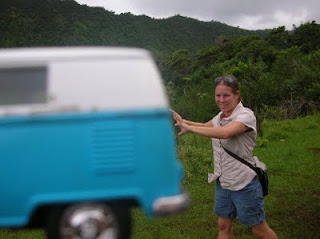


The next stop is the scene when Hurley's entourage pushes the VW van down the hill to jump-start it. It would have been quite a chore to get that van all the way out there for filming, let me tell you. Anyhow, once again, Aaron appears from the back of the Hummer with a toy VW Van. With a little trick photography, you can re-enact pushing it down the hill, too.
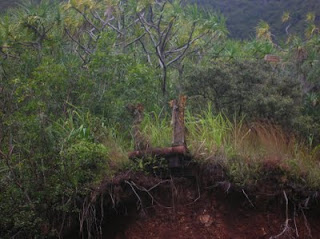
Then, just around the corner from that scene there are two more spots. One was the infamous old bridge that Hurley and Charlie cross in Season 1 and the other was from season 1 as well, when Boone and Shannon are scaling a mountain-side ridge. Basically, they were both filmed at the exact same spot with the camera in different angles. Pretty neat. There were a few shots like this in the valley.
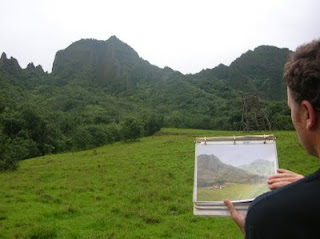
Here you can see a shot from Season 3 when Ben intercepts Jack and company on their way to the radio tower. The establishing shot for the valley is located down below as our guide is holding the picture. Then, the scene where Jack beats Ben up for a while, that's filmed in this exact same location - they just took all the other people out of the shot for it, even though it looked like Jack took Ben aside.
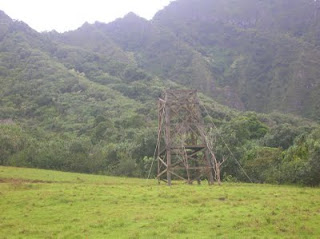
The next stop is the Jughead bomb structure which is still standing. Normally these things would be taken down, but for some reason, the crew has left it up. Do they still need it for season 6? I have no idea.

A little further around the valley is Hurley's golf course, which you'd never recognize, I don't think. Then the tour guide, Aaron, pulls Todd McFarlane's Hurley figure out of the back of the Hummer and you get to have your picture with him. More trick photography ;) In some instances these pictures turn out so well that you can fool your friends, having them believe that you actually met a character out of Lost. I would imagine that if you actually met Jorge Garcia, he likely wouldn't pull out a golf pin with boxer shorts on it just for your picture, though.

What you didn't know about Hurley's golf course is this: it's filmed on the same location as the Gallimimus stampede in Jurassic Park. The log that Tim, Dr. Grant and Lex hide behind while the stampede is going on is still there on the grounds. You can get your picture with it, as well.

More trick photography, we didn't actually hide from a tyrannosaurus. Although, in real life, I'd sacrifice myself to the dinosaur instead of feeding it my wife. Probably.

If you turn around from that very same location, there are three or four big Godzilla footprints from the Mathew Broderick film. They're big - apparently they used to be like 7 feet deep, but horses and cattle fell into them, so they were back-filled before PETA found out. (I'm only guessing about that part about PETA).

The next thing you find up the road is where the 1950's military other's camp is located when Locke meets Richard Alpert for the "first time" chronologically. The tents were all set up amongst those coconut trees. After Locke flashes away to another time, he's literally standing in the same location he was in - but they tore the set down between takes. That was impressive to me, considering all they had to do was point the camera 20 degrees in any direction and you wouldn't be able to tell (and it would have saved hours in tear-down time). But they filmed it right at very same spot, which looks awesome.

Then, on your way out of the valley, you pass by an old military battery. The Ka'a'awa Valley park is privately owned and (if I recall correctly) is like 4,000 acres or something like that. The military back in the old days commandeered about 1,000 of those acres and used the location as an air strip and a way to shoot boats off the coast. All of that is in the past, but the battery is the site of the Tempest Station from Season 4. Inside there are a bunch of posters and autographed stuff to look at.
The next day, on the way to the airport I had a brief opportunity to take a shot of The Searcher, which was Penny's boat in the Season 4 finale. I think they filmed the Season 5 stuff of the Oceanic 6 (+ Desmond and Lapidus) on there, as well. I wish the shot was a bit better, but we were in a shuttle taking us back to the airport - there wasn't really time to stop. The Searcher is the boat on the right, if you zoom in you can see its name on the hull.

This was the second last day of our honeymoon. We didn't see any cast members or crew while we were on the tour BUT we totally bumped into Terry O'Quinn while at the airport the next evening. He was super nice.
We were scanning our carryons through the x-ray machines when my wife spotted him. He was singing to himself, carrying a piece of carry-on luggage and his little guitar. You can't see it, but he was wearing a hat. He was nice enough to stop and let us take a picture. He said they didn't need him for the episode they were filming, so he got a little extra time off. We didn't get to chat much more after that because another couple interjected so that they, too, could get a photo. Otherwise, I'm sure Terry and I would have been close friends.
He didn't ask if he could get a picture of us together on his camera - and I forgot to mention how much I enjoyed his performance in Old School, which I'm sure he would have appreciated ;)

Thursday, November 5, 2009

Check it out

More like, we're checking out.

This is it! Our last day on honeymoon. The Lost Tour from KOS was a good time. We've got to wrap things up here in our hotel room and get out, or else I'd post some more pictures and tell you more about the trip. I've got some plans for all the pictures and things that we took - hopefully it turns out well - and we'll be able to give you a better idea of how surreal the last few weeks have been. We left Peterborough exactly two weeks ago today to start prepping for our wedding - and life hasn't fallen back into a routine since. I can almost see how rockstars can get a bit crazy while they're on the road for long stretches.

Our flight isn't until quarter after eight o'clock tonight, which is like two in the morning in the EST zone - then we get into Dallas/Fort Worth again (around 7:45 in the morning Dallas time). Then we leave Dallas around 10:45 a.m. and fly back to Toronto (getting in around 2 p.m. EST). So - 2 a.m. Friday morning to get home

That's a long trip of flying around, esp. doing most of it overnight. I hope that we're able to sleep on the plane, or else things might get really uncomfortable for us later on.

Besides that - after we check out, because our flight isn't until much later on this evening, we're going to visit the zoo for a while. I doubt we'll get to see everything, but it should help eat up someof the day while we wait for our flight.

We'll be back soon. Take care.

Wednesday, November 4, 2009

Sunset Cruise

We took a nice sunset cruise this evening with a buffet dinner, some dessert with plenty of entertainment all evening. It was very nice - and here are some pictures of it.

First off, the boat was very nice - its name meant "Royalty" which basically boiled down to King of the Sea, or something like that.


Jeez, the guy in this picture sure got allot of sun today.


There was some Polynesian dancing that was displayed for us after dinner.


Our event host was named "Cousin Big Mac," and I have no idea what his honest Christian Name was, but I was considered "Cousin Rya'an" even if my nametag said otherwise. We had a very nice time on the sunset cruise, and there was a very nice couple from Pennsylvania who shared our table.