Showing posts with label dinosaurs. Show all posts

Saturday, February 4, 2023

Spring Chickens | The Two Species of Leptoceratops


There's just that one difference....


Spring Chickens

UpVote on Reddit, Follow on Twitter and Like on Facebook!

Tuesday, June 3, 2014

Friday, April 19, 2013

No. 1 - - Stegosaurus of Colorado

[1] Colorado – Stegosaurus (1982)
shortly after this image was captured, the stegosaurus thagomized Kenny to death.

The coolest state dinosaur is definitively the Stegosaurus.

It looks cool, it’s a total classic and it’s covered in awesome and mysterious plates and spikes. Hailing in many instances from the Morrison Formation, some of which is in Colorado, around 80 samples of stegosaurus have emerged, giving paleontologists a lot of information to work with.

Stegosaurus’ weapon of choice is the Thagomizer, which is the actual name of its four-spiked tail. “Teeth,” “claws” and “horns” aren’t anywhere close to as cool as “thagomizer.”

Also, Colorado deserves wicked points for being a pioneer in naming an official state fossil by doing so in 1982, years before any of its contemporaries.

Stegosaurus is the largest of the stegosaurs, and adapted the awesome thagomizer and rows of plates by the mid-to-late Jurassic era, 150 million years ago, ages before ceratopsians became proficient in adapting horns and frills as deterrents from predators.

Hands down, the best official state dinosaur is stegosaurs.


References:

http://en.wikipedia.org/wiki/Stegosaurus


Wednesday, April 17, 2013

No 2 - - Triceratops of Wyoming

[2] Triceratops – Wyoming (1994) 
 

While not as awesome as stegosaurus, Wyoming has the second best official state dinosaur with the massive triceratops. At 12 tons and up to 9 metres in length, it was a badass monster with a massive skull (among the largest of all terrestrial animals) the largest of which is 2.5 metres in length, making the skull half the size of a stegosaurus - - and that’s just triceratops’ skull!)

Hailing from the Hell Creek formation, 38 skulls of this classic monster have helped make it one of the most famous and well-known dinosaurs of all. And believe it or not, back in the 1800s, the horns were initially believed to belong to a “large and unusual bison,” if you can believe it.


References:
http://en.wikipedia.org/wiki/Triceratops 

Thursday, April 11, 2013

No. 4 - - Astrodon of Maryland

[4] Astrodon – Maryland (1998)


Named after its star-shaped teeth, you probably wouldn’t even see those chompers when you came across an astrodon because they’d be 9 metres up in the frickin’ air! This behemoth brachiosaurid is presumed to have rocked upwards of 20 tons, though considered medium-sized in terms of sauropods.

The specimens were discovered in the Arundel Formation in Maryland back in the 1859 making it one of the earliest discovered dinosaurs in North America ever and the first discovered in Maryland.

That’s pretty cool – plus, Maryland sort of “snagged” the state fossil away from Texas, in a round-about unintentionally sort of way.
 

References:
http://cooldinofacts.wikia.com/wiki/Astrodon

Wednesday, April 10, 2013

No. 5 - - Pleurocoelus of Texas ... or is it Paluxysaurus?

[5]Pleurocoelus – Texas (1997)/maybe Paluxysaurus?

So … this is an awkward situation. It sounds like Texas adopted the Pleurocoelus (a brachiosaurid) back in ’97, but paleontologists “screwed up Texas’s plans” by suggesting that Pleurocoelus is actually an already identified species called Astrodon, which Maryland adopted as their own state fossil in ’98.

This means, for a few years, Texans were happy to have the 15-ton obscurity representing their state, until they learned that they’d adopted a species that might actually be a different species that someone else had already staked a claim to.

“Well, shit,” thought Texas. *
 

 *I’m speculating and paraphrasing

So since 2009 Texas has been mulling over the idea of replacing Pleurocoelus/Astrodon with Paluxysaurus, which is kind of neat, in terms of its placement in sauropod evolution (if Texans believe in that sort of thing).

Paluxysaurus is believed to represent the evolutionary turning point between brachiosaurids and titanosaurs, which were the lineage of sauropods that would survive until the extinction event that ceased the existence of all dinosaurs shortly thereafter.


References:
http://dinosaurs.about.com/od/herbivorousdinosaurs/p/Paluxysaurus.htm 


http://dinosaurs.about.com/od/herbivorousdinosaurs/p/pleurocoelus.htm

Friday, April 5, 2013

No. 6 - - Hylonomus of Nova Scotia

[6] Hylonomus – Nova Scotia (2002)

This isn’t a dinosaur, in fact it’s a small reptile from the Precambrian era, 312 million years ago, ages before the dinosaurs evolved. This could, in a very liberal sense of the word, make Hylonomus the great grand father of dinosaurs, though probably not in any literal or figurative way.

Only 20 centimetres long and not even a dinosaur, this is still Canada’s greatest “state” fossil because it is Canada’s only state fossil, located in the fossilized, club-moss stumps of Joggins, Nova Scotia.

Now, let’s be clear, Canada finds ways to honour its dinosaurs in more scientific ways. Rather than adopting a cool fossil as its official provincial fossil, they instead name the cool fossils after the province (or a big city in the province) which is why we have the wicked-cool Albertasaurus, Edmontonia, Albertaceratops and Edmontosaurus.

British Columbia had a competition back in 2010 to vote for a fossil to be recognized as one of the province’s official symbols, and there was a strong “elasmosaurus lobby” to honour the serpentine aquatic reptile.

I can’t find a single result to come from this competition, but the list of nominees for the competition can be found here.

In any case, none of these nominees are dinosaurs, just as hylonomus isn't, too.


The countdown will resume next Wednesday - tune in then!

References:
http://www.for.gov.bc.ca/land_tenures/fossil_management/designating_a_provincial_fossil/index.html


http://en.wikipedia.org/wiki/Hylonomus

Wednesday, April 3, 2013

Ontario Hasn't a Single Dinosaur to its Name

Growing up, I had absolutely no understanding of the geological composite of the great province of Ontario. The Canadian Shield, mantle and solid rock that makes it a wondrous world of farmlands that recede into elementally furtive boreal forests, moraines, escarpments and eventually tundra meant nothing to me.

That there’s never been a dinosaur discovered in a province that’s so rich is so many ways, with fresh water, farmlands and minerals like gold, nickel, copper, zinc, silver and cobalt, was completely unknown to me.

Which meant digging a deep hole in my parents’ backyard when I was a kid, well into the water table, was a viable dinosaur hunting past time. Every big rock I came across, protected by the bothersome deciduous roots that interfered with my descent, struck a hope that I’d found a fossil.

(I’m fairly certain I broke at least one shovel levering hunks of wet clay from the bottom of that hole – sorry dad).

I pulled a bunch of fist-sized reddish hunks of rock out of the ground, and might have even hung on to some of them, though they’d all be gone by now.

In any case, many years later, I can only admit that it was all a fantasy, no matter how seriously I took it. Ontario just isn’t constructed in a way that will reveal any dinosaur bones. I’ve come to terms with that … finally.

It’s something that Ontario just doesn’t get – BUT other places have embraced their dinosaurs by naming them the official fossils of their states (an in a very few instances, their official provincial fossil as well).

What are some of the coolest state fossils out there?

I am ranking them from worst to best, beginning with No. 8:

[8]Capitalsaurus (1998)


I have this dinosaur ranked as the worst state fossil, and leave it to D.C. to celebrate and commemorate the hell out of the most insubstantial, unimportant, banal discovery in paleontology. Seriously, nobody puts lipstick on a pig like Washington.

In 2001, “capitalsaurus” received its own official day, January 28. It has its own theme song “Them Dino Bones” and there is a block between First and F, Southeast, which has been renamed “Capitalsaurus Court.”

If only all states could honour their official fossils with this much pomp and vigour. While there’s an A for effort, this is the most stupid dinosaur to name as the District of Columbia’s official fossil. Why’d they even bother?!

What made this a good idea? I can’t start off my feelings on this official state fossil in any better way than Michael Gaynor from the Washingtonian put it:

“Unfortunately this specimen was used to try and name a new genus, ‘Capitalsaurus,’ in honor of the nation’s capital,” the Smithsonian website says. “This is not scientifically justified, and the name ‘Capitalsaurus’ has no validity.”

Working with students from two local elementary schools, he [local paleontologist Peter Kranz] presented his findings to the council. It was there that Capitol Hill’s own (maybe) dinosaur benefited from the once-thought-extinct act of political compromise, and the Official Dinosaur Designation Act of 1998 was enacted.
“Capitalsaurus” is not a recognized fossil, species or anything – it’s a completely improvised representation of what could be cool about fossils, and then hyped up with pageantry and children holding hands while swaying back and forth in a circle.

It’s terrible. Easily the very worst official state dinosaur, and some of the animals on this list AREN’T even dinosaurs. That’s how bad “capitalsaurus” is.

References:
http://www.washingtonian.com/blogs/capitalcomment/local-news/happy-capitalsaurus-day-1.php


http://en.wikipedia.org/wiki/List_of_U.S._state_dinosaurs
 

Thursday, February 7, 2013

Ancient Winged Transylvanian Predator Discovered

When you think of winged predators soaring through the Transylvanian evening, you generally think of a mythical bat preying on men, hotly pursued by Dr. Abraham Van Helsing to rid the world of vampires.

However, some cryptozoologists feel that Bram Stoker’s legendary monster story is rooted in the genuine reports of Transylvanians who observed a monstrous, nocturnal flying predator: namely a pterosaur.

The discovery of Eurazhdarcho is the most complete example of an azhdarchid found in Europe so far. According to researchers, its discovery adds credence to a theory about the behavior of these types of creatures.

I’m in no way about to propagate that myth (however cool it would be!) but there is a romantic relationship between discovering a large pterosaur in the Late Cretaceous rocks of the SebeÅŸ-Glod in the Transylvanian Basin, Romania, and Dracula himself.

The location of the discovery is what’s most exciting about this find, too. The SebeÅŸ-Glod has been the source of other prehistoric and fossilized dinosaurs, mammals, turtles, lizards and ancient crocodiles.

It’s a 68-million-year-old formation which senior lecturer in vertebrate palaeontology at the National Oceanography Centre Southampton Gareth Dyke says was comprised of an inland, continental environment which included meandering rivers and swampy regions.

It strengthens the argument to suggest these pterosaurs soared above forests and plains in search of small animal prey.

What makes this pterosaur, Eurazhdarcho langendorfensis, special is that it’s the first azhdarchid pterosaur discovered in Europe, and one of the most complete discoveries of its kind, which helps further illustrate its bizarre form:

A medium-sized wingspan of three metres, long neck, long beak and wings strongly adapted for a soaring lifestyle. Features of its wings and hind-limb bones show it could fold its wings and walk on all fours, as well. 
“Experts have argued for years over the lifestyle and behavior of azhdarchids. It has been suggested that they grabbed prey from the water while in flight, that they patrolled wetlands and hunted in a heron or stork-like fashion, or that they were like gigantic sandpipers, hunting by pushing their long bills into mud,” says Gareth Dyke.
Its discovery strengthens suggestions that azhdarchid pterosaurs were linked to terrestrial floodplains and wooded environments, because Eurazhdarcho lived alongside other gigantic contemporary pterosaurs, like Hatzegopteryx thambema.

References:
http://www.sciencerecorder.com/news/researchers-discover-a-new-type-of-flying-reptile-from-the-age-of-dinosaurs/ 
http://trap.it/#!traps/id/46cc09ce-e70f-48aa-94b5-1f1fc81d7c1e/jump/6E4T1z2bv002q6IvMa9u

Thursday, January 31, 2013

Something missing in my Journey to the Centre of the Earth

Was I crazy to think Journey to the Centre of the Earth would have dinosaurs? My wife read it a few months ago, and I asked her while I was nearing the end of the book ... Hey? I don't think there are going to be dinosaurs in this.

She answered, uncertainly, "No, I think they're in there.... It was so long ago, but I think they were?"

I just knocked Jules Verne's Journey to the Centre of the Earth, off my reading list and .... it was fine, but I think there's a major revision in the first sentence that needs to be made.
On the 24th of May, 1863, a Sunday, my uncle, Professor Lindenbrock, came rushing back to his little house, No. 19 in the Konigstrasse, one of the oldest streets in the oldest part of the city of Hamburg.              - Verne
How it should begin.
There are no dinosaurs in this book. On the 24th of May, 1863, a Sunday, my uncle, Professor Lindenbrock, came rushing back to his little house, No. 19 in the Konigstrasse, one of the oldest streets in the oldest part of the city of Hamburg.
Notice the important difference? I had no idea that there weren't going to be dinosaurs. Was it unreasonable to think there would be? In 2008's adaptation in 3D, dinosaurs were fairly prominent in the marketing of the film.

This Tyrannosaurus is easily 1,000 ft. long, and 20 times larger than necessary.
In fact, in almost every adaptation of the text into film/television has featured dinosaurs. Heck, even Wikipedia has the novel (that has no dinosaurs in it) categorized under "Novels about dinosaurs". NOT the films, the television shows, etc, but the science fiction novel itself.

But, the 3D flick from a few years ago can't simply be the only reason this misunderstanding is so prominent, is it?

In the 1959 film of the same name, had a Dimetrodon and a "giant chameleon" in it, the classic types, which were just lizards with horns glued onto them.Those weren't in the book, but begin to illustrate when "dinosaurs" began to seep their way into the retelling of this story.

In a 1967 animated version of the text adapted for television has a griffon, a three-headed helldog, and an army of Roman soldiers, though I can't find much about dinosaurs in it. I think there was an episode called "Fossils Revenge" or something, which probably had dinosaurs in it?

A 1978 version of the film had dinosaurs in it.

By 1999, this tv series is using dinosaurs as a dominant selling feature:

Here is a "Wal*Mart" version of the classic appears to have a dinosaur right on the cover of the book:
There were plesiosaurs in the book, this COULD just
be a beached plesiosaur attacking Lindenbrock?
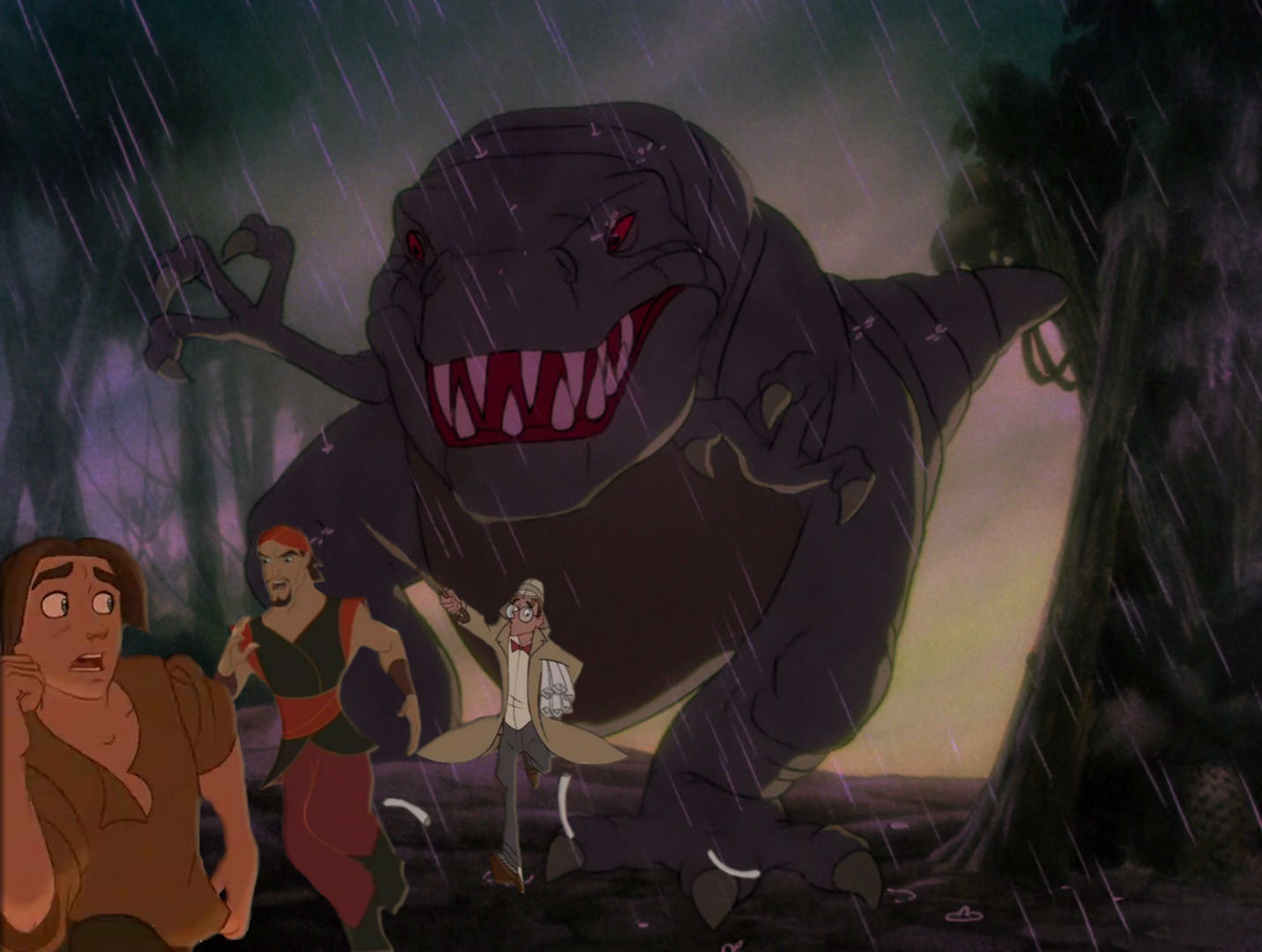
Here's some cartoon featuring Lindenbrock running from a tyrannosaurus as well.

In any case, if dinosaurs had been as prominent in the 1860s as they are now (they'd only first been discovered in the 1820s or something like that) I'm sure Verne woulda loaded up his prehistoric realm with the animals, but ... he just didn't.

So, beware, it's a neat book with a fun journey, but ... no dinosaurs.